Home › Industrial and Heavy-Duty Asphalt Paving
Handle heavy traffic with industrial asphalt paving in Huntsville, AL. We design and install thick, reinforced asphalt sections for truck yards, loading docks, and warehouses where loads and turning stresses are high.
Precision Asphalt Huntsville provides professional industrial asphalt paving throughout Huntsville, AL, Alabama and the surrounding area. Our licensed, insured crew delivers safe, clean, on-time work with a free estimate before anything begins. Call (256) 292-9329 or request your free quote.
Industrial Asphalt Paving for Huntsville Facilities
Industrial asphalt paving is different from standard parking lots or driveways. At Precision Asphalt Huntsville, we design and build pavement to handle loaded semis, forklifts, dumpsters, fuel trucks, and constant turning traffic that is common at plants and distribution yards around Huntsville and the Tennessee Valley. Our work focuses on heavy-duty sections that do not rut, shove, or break up under real-world industrial use.
We regularly pave for manufacturing facilities near Research Park, warehouse and logistics yards along I 565, and industrial sites in North and South Huntsville. Those properties see a mix of tractor trailers, delivery box trucks, and employee vehicles. Each area needs a different structure under the asphalt. Light car traffic might only need 3 to 4 inches of asphalt on a moderate base. Truck lanes, dock aprons, and dumpster pads often need 6 inches or more of asphalt over a thicker stone base or a concrete pad. The key is to match the pavement design to the exact loads and traffic patterns for your site.
Before we bid any industrial asphalt paving project, we ask how you actually use the space. We want to know where trucks turn, where trailers are parked long-term, where pallets are staged, and whether you use tracked equipment or rubber-tired equipment. This information, combined with soil conditions and drainage on your Huntsville property, informs our design so that your heavy-duty pavement lasts instead of failing in 3 or 4 years.
Site Evaluation, Design, and Load Calculations
A durable industrial pavement starts with a realistic assessment of loading and subgrade. Precision Asphalt Huntsville begins each project with a site walk and soil review. In many Huntsville industrial parks the native soil has a significant clay content. Clay holds water and loses bearing strength when saturated, which means it must either be undercut and replaced with stone or stabilized with lime or cement before we ever place base stone.
We look at three primary design factors: expected traffic loads, frequency of those loads, and environmental conditions. For example, a distribution center near the airport with 100 trucks per day will need heavier asphalt sections than a small fabrication shop that only sees occasional deliveries. Typically, we design car-only areas with 2 to 3 inches of surface and binder over 6 inches of compacted aggregate. For truck lanes and dock areas, we commonly specify 4 to 5 inches of binder and surface over 8 to 12 inches of stone or use full-depth asphalt in multiple lifts.
Where extremely heavy loading or point loads are present, such as under dumpster pads, fuel tanks, or where loading legs stand, we may recommend reinforced concrete pads tied into the asphalt, or a thicker industrial asphalt section with polymer-modified binders. We also consider Huntsville’s temperature swings. While winters are usually mild, freeze-thaw cycles still occur, and high summer temperatures can soften poorly designed mixes. We select asphalt mixes with the right binder grade to resist both rutting in August heat and cracking in colder months.
How Industrial and Heavy-Duty Asphalt Paving Is Installed
Industrial asphalt paving follows the same general steps as lighter paving, but there is less margin for shortcuts. Precision Asphalt Huntsville breaks the process into clear stages so facility managers know exactly what will happen on site.
1. Demolition and undercut: We remove existing failed pavement and soft subgrade. In older Huntsville facilities, we often find thin pavement placed directly on native soil. Soft or organic material is excavated and replaced with suitable structural fill.
2. Subgrade shaping and stabilization: The exposed soil is graded to establish proper slopes away from buildings and critical equipment. If soils test weak or we encounter expansive clay, we may disk in lime or cement, or use a geotextile or geogrid to spread loads before placing aggregate. This step is critical under truck lanes and dock aprons.
3. Aggregate base placement: We place graded crushed stone in lifts, typically 4 inches at a time, compacting each lift with vibratory rollers to achieve target density. For heavy-duty sections around Huntsville warehouses, base thickness usually ranges from 8 to 12 inches, depending on load requirements and soil capacity.
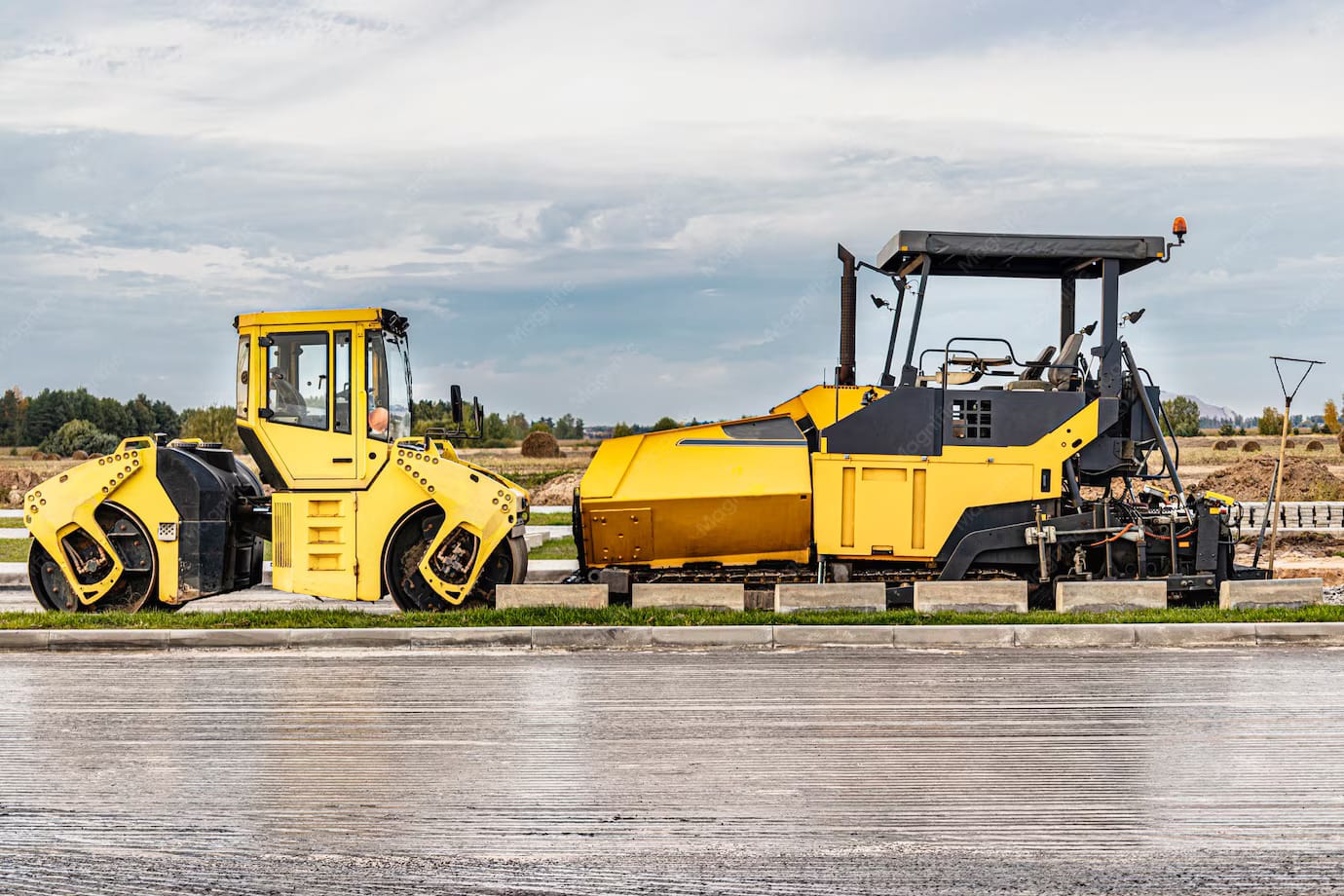
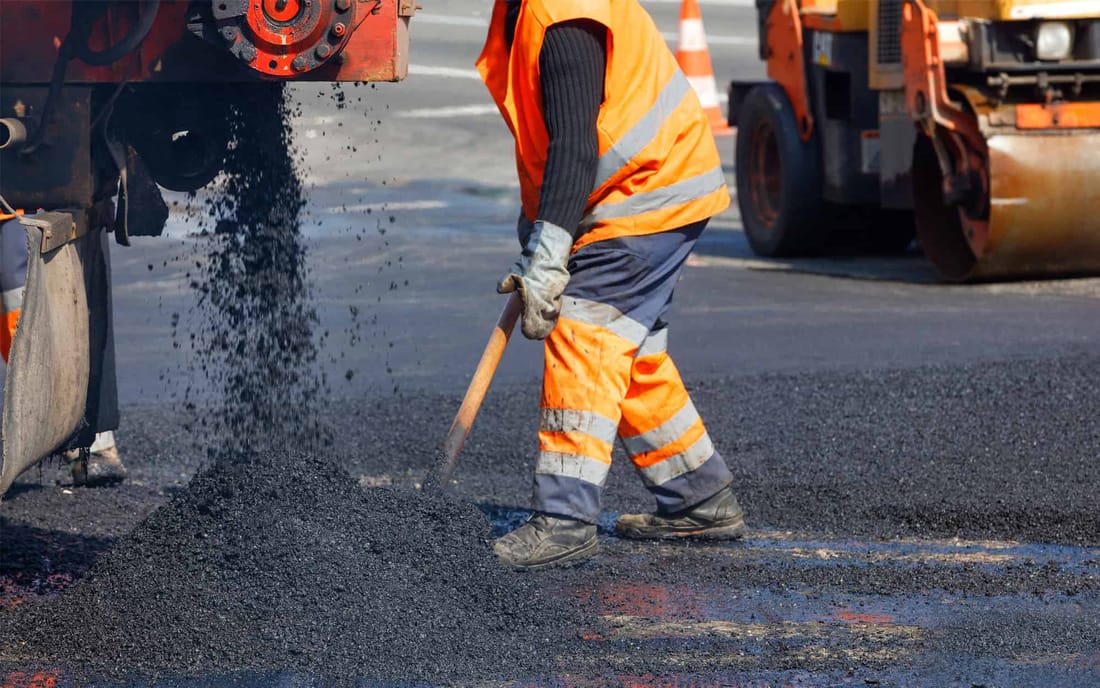
4. Asphalt placement in multiple lifts: Industrial sections are rarely done in a single layer. We usually install a structural binder course first, often 2 to 4 inches, then a tighter surface course of 1.5 to 2 inches. Each lift is paved with a self-propelled paver, then compacted while hot with steel-drum rollers. Joints are staggered between lifts to avoid creating a weak vertical seam under wheel paths.
5. Joint and detail work: Areas around drains, building entrances, concrete pads, and trench drains receive extra attention. We sawcut clean joints and use tack coat along all cold joints and tie-ins to existing pavement so the new and old surfaces bond properly. Poor joint work is a common failure point in industrial yards, so we do not rush this step.
6. Marking, curing, and turnover: Once the asphalt has cooled and firmed up, typically within 24 hours in Huntsville’s climate, we stripe traffic lanes, dock numbers, and safety zones. Heavy truck traffic is usually allowed after that initial period, though we may recommend a short restriction on extremely tight turning areas to reduce early scuffing.
Cost Drivers and Ways to Control Your Budget
Industrial asphalt paving costs more per square foot than a standard parking lot, mainly because of thicker sections, better base, and more complex detailing. Precision Asphalt Huntsville is upfront about what drives price so you can make informed decisions.
The biggest cost factors are: excavation and undercut depth, total stone base thickness, asphalt thickness and mix type, site drainage improvements, and access constraints. If your Huntsville facility sits on weak soils or has chronic ponding, more money will go into undercutting, stabilization, and drainage structures. On the other hand, if you already have a stable gravel yard that just needs paving, your cost per square foot will be much lower.
Mix selection also affects cost. A standard industrial mix with a conventional binder will be less expensive than a polymer-modified mix designed for high temperature rut resistance. We may recommend spending a bit more on mix in specific areas like tight truck turns or busy dock aprons, while using standard mixes in straight driving lanes to balance performance and budget.
Phasing is another way to control cost and downtime. Many Huntsville manufacturers cannot shut down all truck traffic at once. We often break work into phases, such as paving half the dock bays at a time or completing truck lanes on weekends. While extra mobilizations add a small cost, this approach can prevent lost production and overtime for your staff.
During estimating, we can price several options: a minimum spec that meets basic needs, a preferred spec with longer life, and an upgraded spec for critical high-load zones. This makes it clear where dollars are buying extra durability and where you can safely economize.
Local Conditions, Common Problems, and How We Address Them
Industrial pavements in Huntsville face a specific set of issues: clay soils, occasional freeze-thaw, high summer heat, and evolving truck traffic patterns as businesses grow. Precision Asphalt Huntsville has rebuilt many yards and truck courts that failed early because these factors were not considered in the original design.
Common problems we see include: rutting in truck wheel paths, shoving and heaving at dock approaches, alligator cracking in trailer storage areas, standing water near loading docks, and edge failures where asphalt transitions to gravel or grass. Each problem has a cause, and we tailor repairs accordingly instead of overlaying everything and hoping for the best.
For rutting and shoving, we look at both structure and mix. Often, the base is too thin or poorly compacted, or the mix is too soft for summer loads. Repairs typically involve milling out the deformed area, rebuilding the base, and replacing with a stiffer binder course followed by a dense surface. At dock doors, we may add concrete headers or reinforced concrete slabs to take the brunt of trailer impact.
Drainage is another local concern. In some older Huntsville industrial parks, yards were built nearly flat, which seemed fine when they were gravel. Once paved, water had nowhere to go and began infiltrating joints and edges. When we reconstruct these areas, we introduce positive slopes toward inlets, add new drains where necessary, and seal all concrete and building tie-ins to limit water penetration.
Because many facilities expand over time, we also plan for future modifications. When paving, we can leave provisions for additional dock doors, future building expansions, or new utility runs. For example, we might route pavements to allow for future crane pads or reserve reinforced zones where heavier equipment may later operate, which reduces the need for disruptive reconstruction later.
Planning, Scheduling, and What to Expect Working With Us
Industrial asphalt paving is a disruption if it is not planned carefully. Precision Asphalt Huntsville works with plant managers, safety officers, and logistics coordinators to plan work in a way that keeps product moving and employees safe.
Early in the process, we map out your critical truck routes, shift changes, and production schedules. From that, we propose a phasing plan that shows which areas will be closed and when, where temporary truck paths will run, and how emergency access will be maintained. For many Huntsville facilities, we schedule base work on normal workdays and asphalt placement during off-hours or weekends to limit impact.
Before mobilization, we provide a clear scope showing thicknesses, materials, and details so there are no surprises. During construction, there will be noise, equipment, and temporary changes to access. We post signage, coordinate with your staff on flagging if needed, and maintain daily communication about progress and any unexpected conditions, such as unsuitable subgrade or hidden utilities.
After completion, we walk the site with you to review slopes, drainage, and finished work. We explain realistic expectations for life span based on your traffic and maintenance habits. For heavy-duty industrial sections in Huntsville, a well designed and properly maintained pavement can often serve 15 to 20 years before major rehabilitation. We also discuss a simple maintenance plan, including sealcoating where appropriate, crack sealing schedules, and how to handle minor oil or chemical spills so they do not damage the asphalt.
If you are planning new construction, a yard expansion, or a full reconstruction of a failing truck court in Huntsville or nearby communities, we can help you design the pavement structure early so it fits with the overall site plan and utilities instead of becoming a last minute problem.